
(This article was originally published at Statistical Modeling, Causal Inference, and Social Science, and syndicated at StatsBlogs.)
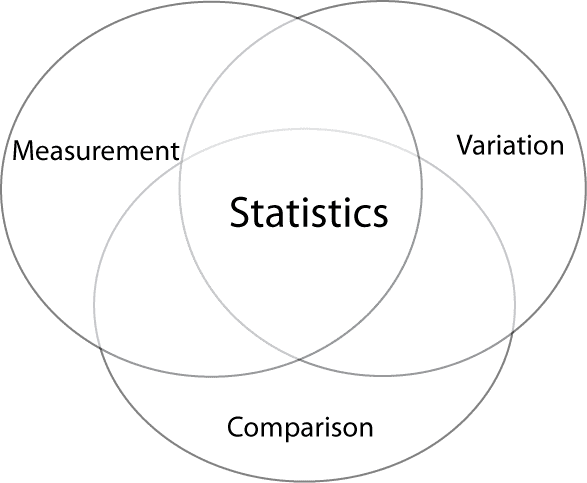
As I wrote a couple years ago:
Statistics does not require randomness. The three essential elements of statistics are measurement, comparison, and variation. Randomness is one way to supply variation, and it’s one way to model variation, but it’s not necessary. Nor is it necessary to have “true” randomness (of the dice-throwing or urn-sampling variety) in order to have a useful probability model.
For my money, the #1 neglected topic in statistics is measurement.
In most statistics texts that I’ve seen, there’s a lot on data analysis and some stuff on data collection—sampling, random assignment, and so forth—but nothing at all on measurement. Nothing on reliability and validity but, even more than that, nothing on the concept of measurement, the idea of considering the connection between the data you gather and the underlying object of your study.
It’s funny: the data model (the “likelihood”) is central to much of the theory and practice of statistics, but the steps that are required to make this work—the steps of measurement and assessment of measurements—are hidden.
When it comes to the question of how to take a sample or how to randomize, or the issues that arise (nonresponse, spillovers, selection, etc.) that interfere with the model, statistics textbooks take the practical issues seriously—even an intro statistics book will discuss topics such as blinding in experiments and self-selection in surveys. But when it comes to measurement, there’s silence, just an implicit assumption that the measurement is what it is, that it’s valid and that it’s as reliable as it needs to be.
Bad things happen when we don’t think seriously about measurement
And then what happens? Bad, bad things.
In education—even statistics education—we don’t go to the trouble of accurately measuring what students learn. Why? Part of it is surely that measurement takes effort, and we have other demands on our time. But it’s more than that. I think a large part is that we don’t carefully think about evaluation as a measurement issue and we’re not clear on what we want students to learn and how we can measure this. Sure, we have vague ideas, but nothing precise. In other aspects of statistics we aim for precision, but when it comes to measurement, we turn off our statistics brain. And I think this is happening, in part, because the topic of measurement is tucked away in an obscure corner of statistics and is then forgotten.
And in research too, we see big problems. Consider all those “power = .06″ experiments, these “Psychological Science”-style papers we’ve been talking so much about in recent years. A common thread in these studies is sloppy, noisy, biased measurement. Just a lack of seriousness about measurement and, in particular, a resistance to the sort of within-subject designs which much more directly measure the within-person variation that is often of interest in such studies.
Measurement, measurement, measurement. It’s central to statistics. It’s central to how we learn about the world.
The post What’s the most important thing in statistics that’s not in the textbooks? appeared first on Statistical Modeling, Causal Inference, and Social Science.
Please comment on the article here: Statistical Modeling, Causal Inference, and Social Science
