
(This article was originally published at The DO Loop, and syndicated at StatsBlogs.)
Although I currently work as a statistician, my original training was in mathematics. In many mathematical fields there is a result that is so profound that it earns the name "The Fundamental Theorem of [Topic Area]." A fundamental theorem is a deep (often surprising) result that connects two or more seemingly unrelated mathematical ideas.
It is interesting that statistical textbooks do not usually highlight a "fundamental theorem of statistics." In this article I briefly and informally discuss some of my favorite fundamental theorems in mathematics and cast my vote for the fundamental theorem of statistics.
The fundamental theorem of arithmetic
The fundamental theorem of arithmetic connects the natural numbers with primes. The theorem states that every integer greater than one can be represented uniquely as a product of primes.
This theorem connects something ordinary and common (the natural numbers) with something rare and unusual (primes). It is trivial to enumerate the natural numbers, but each natural number is "built" from prime numbers, which defy enumeration. The natural numbers are regularly spaced, but the gap between consecutive prime numbers is extremely variable. If p is a prime number, sometimes p+2 is also prime (the so-called twin primes), but sometimes there is a huge gap before the next prime.
The fundamental theorem of algebra
The fundamental theorem of algebra connects polynomials with their roots (or zeros). Along the way it informs us that the real numbers are not sufficient for solving algebraic equation, a fact known to every child who has pondered the solution to the equation x2 = –1. The fundamental theorem of algebra tells us that we need complex numbers to be able to find all roots. The theorem states that every nonconstant polynomial of degree n has exactly n roots in the complex number system. Like the fundamental theorem of arithmetic, this is an "existence" theorem: it tells you the roots are there, but doesn't help you to find them.
The fundamental theorem of calculus
The fundamental theorem of calculus (FTC) connects derivatives and integrals. Derivatives tell us about the rate at which something changes; integrals tell us how to accumulate some quantity. That these should be related is not obvious, but the FTC says that the rate of change for a certain integral is given by the function whose values are being accumulated. Specifically, if f is any continuous function on the interval [a, b], then for every value of x in [a,b] you can compute the following function:
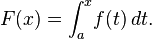
The FTC states that F'(x) = f(x). That is, derivatives and integrals are inverse operations.
Unlike the previous theorems, the fundamental theorem of calculus provides a computational tool. It shows that you can solve integrals by constructing "antiderivatives."
The fundamental theorem of linear algebra
Not everyone knows about the fundamental theorem of linear algebra, but there is an excellent 1993 article by Gil Strang that describes its importance. For an m x n matrix A, the theorem relates the dimensions of the row space of A (R(A)) and the nullspace of A (N(A)). The result is that dim(R(A)) + dim(N(A)) = n.
The theorem also describes four important subspaces and describes the geometry of A and At when thought of as linear transformations. The theorem shows that some subspaces are orthogonal to others. (Strang actually combines four theorems into his statement of the Fundamental Theorem, including a theorem that motivates the statistical practice of ordinary least squares.)
The fundamental theorem of statistics
Although most statistical textbooks do not single out a result as THE fundamental theorem of statistics, I can think of two results that could make a claim to the title. These results are based in probability theory, so perhaps they are more aptly named fundamental theorems of probability.
- The Law of Large Numbers (LLN) provides the mathematical basis for understanding random events. The LLN says that if you repeat a trial many times, then the average of the observed values tend to be close to the expected value. (In general, the more trials you run, the better the estimates.) For example, you toss a fair die many times and compute the average of the numbers that appear. The average should converge to 3.5, which is the expected value of the roll because (1+2+3+4+5+6)/6 = 3.5. The same theorem ensures that about one-sixth of the faces are 1s, one-sixth are 2s, and so forth.
- The Central Limit theorem (CLT) states that the mean of a sample of size n is approximately normally distributed when n is large. Perhaps more importantly, the CLT provides the mean and the standard deviation of the sampling distribution in terms of the sample size, the population mean μ, and the population variance σ2. Specifically, the sampling distribution of the mean is approximately normally distributed with mean μ and standard deviation σ/sqrt(n).
Of these, the Central Limit theorem gets my vote for being the Fundamental Theorem of Statistics. The LLN is important, but hardly surprising. It is the basis for frequentist statistics and assures us that large random samples tend to reflect the population. In contrast, the CLT is surprising because the sampling distribution of the mean is approximately normal regardless of the distribution of the original data! As a bonus, the CLT can be used computationally. It forms the basis for many statistical tests by estimating the accuracy of a statistical estimate. Lastly, the CLT connects important concepts in statistics: means, variances, sample size, and accuracy of point estimates.
Do you have a favorite "Fundamental Theorem"? Do you marvel at an applied theorem such as the fundamental theorem of linear programming or chuckle at a pseudo-theorems such as the fundamental theorem of software engineering? Share your thoughts in the comments.
Please comment on the article here: The DO Loop
