Blog Archives

R and Python: Theory of Linear Least Squares

December 15, 2015
By
R and Python: Theory of Linear Least Squares

In my previous article, we talked about implementations of linear regression models in R, Python and SAS. On the theoretical sides, however, I briefly mentioned the estimation procedure for the parameter $\boldsymbol{\beta}$. So to help us understand h...

Read more »

R, Python, and SAS: Getting Started with Linear Regression

August 17, 2015
By
R, Python, and SAS: Getting Started with Linear Regression

Consider the linear regression model, $$ y_i=f_i(\boldsymbol{x}|\boldsymbol{\beta})+\varepsilon_i, $$ where $y_i$ is the response or the dependent variable at the $i$th case, $i=1,\cdots, N$ and the predictor or the independent variable is the $\boldsymbol{x}$ term defined in the mean function $f_i(\boldsymbol{x}|\boldsymbol{\beta})$. For simplicity, consider the following simple linear regression (SLR) model, $$ y_i=\beta_0+\beta_1x_i+\varepsilon_i. $$ To obtain the (best) estimate of $\beta_0$ and $\beta_1$, we solve for the least residual sum of…

Read more »

Parametric Inference: Karlin-Rubin Theorem

July 20, 2015
By
Parametric Inference: Karlin-Rubin Theorem

A family of pdfs or pmfs $\{g(t|\theta):\theta\in\Theta\}$ for a univariate random variable $T$ with real-valued parameter $\theta$ has a monotone likelihood ratio (MLR) if, for every $\theta_2>\theta_1$, $g(t|\theta_2)/g(t|\theta_1)$ is a monotone ...

Read more »

Parametric Inference: Likelihood Ratio Test Problem 2

May 23, 2015
By
Parametric Inference: Likelihood Ratio Test Problem 2

More on Likelihood Ratio Test, the following problem is originally from Casella and Berger (2001), exercise 8.12.ProblemFor samples of size $n=1,4,16,64,100$ from a normal population with mean $\mu$ and known variance $\sigma^2$, plot the power functio...

Read more »

Parametric Inference: Likelihood Ratio Test Problem 1

May 21, 2015
By

Another post for mathematical statistics, the problem below is originally from Casella and Berger (2001) (see Reference 1), exercise 8.6. ProblemSuppose that we have two independent random samples $X_1,\cdots, X_n$ are exponential($\theta$), and $Y_1,\...

Read more »

Parametric Inference: The Power Function of the Test

May 1, 2015
By
Parametric Inference: The Power Function of the Test

In Statistics, we model random phenomenon and make conclusions about its population. For example, in an experiment of determining the true heights of the students in the university. Suppose we take sample from the population of the students, and consid...

Read more »

Parametric Inference: Likelihood Ratio Test by Example

April 27, 2015
By
Parametric Inference: Likelihood Ratio Test by Example

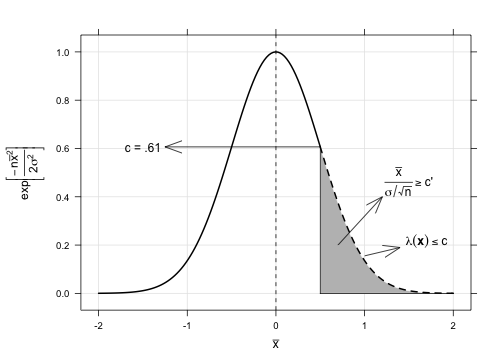
Hypothesis testing have been extensively used on different discipline of science. And in this post, I will attempt on discussing the basic theory behind this, the Likelihood Ratio Test (LRT) defined below from Casella and Berger (2001), see reference 1...

Read more »

SAS®: Getting Started with PROC IML

April 25, 2015
By

Another powerful procedure of SAS, my favorite one, that I would like to share is the PROC IML (Interactive Matrix Language). This procedure treats all objects as a matrix, and is very useful for doing scientific computations involving vectors and matrices. To get started, we are going to demonstrate and discuss the following: Creating and Shaping Matrices;Matrix Query;Subscripts;Descriptive Statistics;Set Operations;Probability Functions and Subroutine;Linear Algebra;Reading and Creating Data;Above outline is based…

Read more »

Python and R: Basic Sampling Problem

April 16, 2015
By

In this post, I would like to share a simple problem about sampling analysis. And I will demonstrate how to solve this using Python and R. The first two problems are originally from Sampling: Design and Analysis book by Sharon Lohr.ProblemsLet $N=6$ an...

Read more »

Probability Theory: Convergence in Distribution Problem

March 6, 2015
By

Let's solve some theoretical problem in probability, specifically on convergence. The problem below is originally from Exercise 5.42 of Casella and Berger (2001). And I just want to share my solution on this. If there is an incorrect argument below, I ...

Read more »


Subscribe

Email:

  Subscribe