Posts Tagged ‘ Regression Modelling ’

Sorting correlation coefficients by their magnitudes in a SAS macro

Sorting correlation coefficients by their magnitudes in a SAS macro

Theoretical Background Many statisticians and data scientists use the correlation coefficient to study the relationship between 2 variables.  For 2 random variables, and , the correlation coefficient between them is defined as their covariance scaled by the product of their standard deviations.  Algebraically, this can be expressed as . In real life, you can never […]

Read more »

Why I use Panel/Multilevel Methods

July 24, 2015
By
Why I use Panel/Multilevel Methods

I don’t understand why any researcher would choose not to use panel/multilevel methods on panel/hierarchical data. Let’s take the following linear regression as an example: , where is a random effect for the i-th group. A pooled OLS regression model for the above is unbiased and consistent. However, it will be inefficient, unless for all […]

Read more »

Coal and the Conservatives

May 11, 2015
By
Coal and the Conservatives

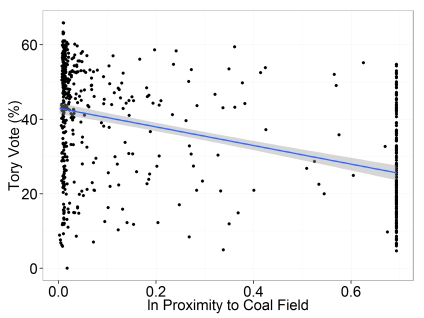
Interesting election results in the UK over the weekend, where the Conservatives romped to victory. This was despite a widespread consensus that neither the Conservative or Labour party would get a majority. This was a triumph for uncertainty and random error over the deterministic, as none of the statistical forecasts appeared to deem such a […]

Read more »

Brazil’s Host Advantage

June 13, 2014
By
Brazil’s Host Advantage

If history can tell us anything about the World Cup, it’s that the host nation has an advantage of all other teams. Evidence of this was presented last night as the referee in the Brazil-Croatia match unjustly ruled in Brazil’s favour on several occasions. But what it is the statistical evidence of a host advantage? […]

Read more »

The ivlewbel Package. A new way to Tackle Endogenous Regressor Models.

May 15, 2014
By
The ivlewbel Package. A new way to Tackle Endogenous Regressor Models.

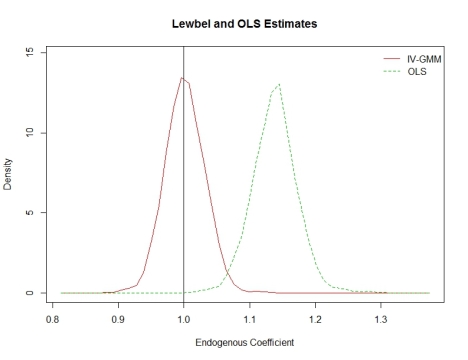
In April 2012, I wrote this blog post demonstrating an approach proposed in Lewbel (2012) that identifies endogenous regressor coefficients in a linear triangular system. Now I am happy to announce the release of the ivlewbel package, which contains a function through which Lewbel’s method can be applied in R. This package is now available […]

Read more »

The ivlewbel Package. A new way to Tackle Endogenous Regressor Models.

May 15, 2014
By
The ivlewbel Package. A new way to Tackle Endogenous Regressor Models.

In April 2012, I wrote this blog post demonstrating an approach proposed in Lewbel (2012) that identifies endogenous regressor coefficients in a linear triangular system. Now I am happy to announce the release of the ivlewbel package, which contains a function through which Lewbel’s method can be applied in R. This package is now available […]

Read more »

IV Estimates via GMM with Clustering in R

April 1, 2014
By
IV Estimates via GMM with Clustering in R

In econometrics, generalized method of moments (GMM) is one estimation methodology that can be used to calculate instrumental variable (IV) estimates. Performing this calculation in R, for a linear IV model, is trivial. One simply uses the gmm() function in the excellent gmm package like an lm() or ivreg() function. The gmm() function will estimate […]

Read more »

IV Estimates via GMM with Clustering in R

April 1, 2014
By
IV Estimates via GMM with Clustering in R

In econometrics, generalized method of moments (GMM) is one estimation methodology that can be used to calculate instrumental variable (IV) estimates. Performing this calculation in R, for a linear IV model, is trivial. One simply uses the gmm() function in the excellent gmm package like an lm() or ivreg() function. The gmm() function will estimate […]

Read more »

Detecting Weak Instruments in R

September 23, 2013
By
Detecting Weak Instruments in R

Any instrumental variables (IV) estimator relies on two key assumptions in order to identify causal effects: That the excluded instrument or instruments only effect the dependent variable through their effect on the endogenous explanatory variable or variables (the exclusion restriction), That the correlation between the excluded instruments and the endogenous explanatory variables is strong enough […]

Read more »

Detecting Weak Instruments in R

September 23, 2013
By
Detecting Weak Instruments in R

Any instrumental variables (IV) estimator relies on two key assumptions in order to identify causal effects: That the excluded instrument or instruments only effect the dependent variable through their effect on the endogenous explanatory variable or variables (the exclusion restriction), That the correlation between the excluded instruments and the endogenous explanatory variables is strong enough […]

Read more »


Subscribe

Email:

  Subscribe